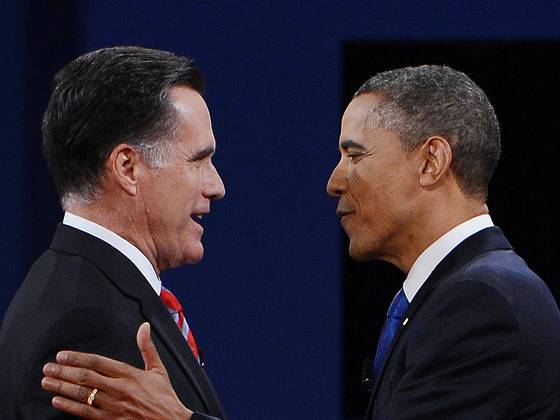
How the world sees the foreign policy debate between
Mitt Romney and President Obama largely depends on what side of the
political spectrum one falls.
4:16PM EDT October 23. 2012 - Commentators
and people around the globe gave mixed opinions to the performances of
Mitt Romney and President Obama in Tuesday's debate that focused largely
on foreign policy.
"Obama (came out on top) but to an extent both
tried to be the other," said Omar R. Quraishi in Karachi, editor of the
editorial pages of the English-language Pakistani newspaper,
Express Tribune, which is affiliated with the
New York Times's global editions.
"Obama
sounded firm and assertive, kind of like a Republican, and Romney tried
to ensure that the female vote, which has apparently risen for him,
doesn't go away, but tried not to sound like a war-mongering
Republican."
German weekly magazine
Der Spiegel, which is
generally highly critical of U.S. conservatives, said that Obama had
"clearly won the debate" but that Romney had "neutralized" the
president's attacks on his record. A commentator in the magazine
complained that neither candidate adequately addressed the most pressing
challenges facing the "wobbly" global power - climate change.
But British commentators said that Romney had had the "best night."
"The
final debate probably won't shift the opinion polls, but it saw a
marked change in emphasis in Mr. Romney's foreign policy," said Mark
Mardell, the BBC's North American editor.
"That is a danger for
him in that it resurrects the old flip-flopping charge. But it also
suggests a new confidence that he has to convince people he is safe
enough to entrust with the presidency," he said.
But others said
that any performance by Obama was going to stand out well following the
first debate, in which the president himself said he did not do well.
"This
whole series of debates is a little bit overshadowed by the
extraordinarily poor performance of Obama in the initial debate," Ned
Wiley, an American representative of Republicans Abroad, who has been
living in Germany for 12 years and in Europe
for three decades.
The
two contenders in the presidential race competed over policy in the
Middle East in a year that has seen demonstrations flair up, increasing
conflict in Syria, a renewed al-Qaeda presence and attacks, and Iran
refusing to end its nuclear enrichment program.
Tim Stanley of
The Telegraph,
a right-of-center newspaper in the United Kingdom, said Romney won the
debate by appearing more presidential than Obama. He said Obama
"insulted, patronized and mocked his opponent rather than put across a
constructive argument. His performance was rude and unpresidential."
Yossi Mekelberg, program director of international relations at Regent's College in London, did not see it that way.
"Romney
accused Obama of not dong enough on the peace process but he didn't
suggest any alternative," Mekelberg said. "I think Romney's speeches
when he visited Israel didn't suggest that he would be the broker of
peace between Israel and Palestine if he was elected… The
Israeli-Palestinian peace process is in deep freeze right now, the
question we all ask ourselves is whether a second-term Obama would
assert himself and actually do the right things to promote the peace
process."
Mekelberg said the debate was more about personalities than policies.
"In
many ways both sides agreed," he said. "Obama presented himself as very
presidential compared to Romney's inexperience in foreign affairs."
But
what was clearly missing in the debate, said some, was any discussion
over Europe and the continuing financial crisis that has led some
countries to the brink of economic ruin.
"What will be done to maintain relations with important European trading partners wasn't even mentioned," Wiley said.
Analysts said it was unlikely that the debate would swing the vote this time round and that divisions had already been made.
"People
who support the Egyptian revolution want Obama," said Said Sadek, a
political sociologist in Cairo. "People against the Egyptian revolution
and its result that led to the Muslim Brotherhood coming to power
support Romney. This is the main division."
The Palestinian government was not pleased with the responses of both candidates.
Nabil
Abu Rdeneh, a spokesman for Palestinian President Mahmoud Abbas, said
"it should be clear" that without resolution, "there will be no success
for American policy in the Middle East."
Writing in YnetNews.com
in Israel, Yitzhak Benhorin said Obama mastered more facts but Romney
wanted to drag Romney into a trap and present him as someone who is not
qualified to serve as commander in chief and as someone who will get the
USA involved in a third war in the Middle East.
"But Romney did not fall into this trap and even agreed with the president on some issues," he said.
Ruthie
Blum, author of "To Hell in a Handbasket: Carter, Obama, and the 'Arab
Spring,'" wrote in Israel Hayom that Romney was able to shine a light on
Obama's past failures to stand up to Iran's leadership.
"Listening
to the appeasement king of the West assert that he laid down the law to
the mullahs from the get-go, that his sanctions have been working, and
that he will never allow Tehran to proceed toward completing the bomb,
one might
conceivably be lulled into forgetting what he has been up to," she said.
Dan
Russell, a 50-year-old university lecturer in the United Kingdom said
the election outcome would also have a global impact because "we're one
big world".
"I hope Obama will win in the end," he said. "Obama isn't perfect though."
Russell
said Obama has not delivered on a lot of things but claimed that's
partly to do with the split Congress. However, Obama had a Democratic
super-majority control of both the House and Senate in his first two
years in office and techincally speaking could have passed any
legislation he promoted without Republican votes, and sometimes did.
In
China, on the booming micro-blog service Weibo, many Chinese Internet
users offered comment. Some criticized the U.S. "America derived profit
from China, but American people think they suffer injustice. American
politicians pleased American people's prejudice," wrote Tao Yongyi, an
independent economist, after the second debate.
Others reflected
on what the debate revealed about China's closed, one party system,
which will next month reveal new Communist Party leadership, after a
thoroughly closed-door process. "How many Chinese leaders dare to debate
in front of all the people in the world?" asked Cao Yexun, an online
writer from Chengdu in southwest China.
The U.S. Presidential
debate was all over China's state-run CCTV Television, but it reflects
China's "sorrow", wrote Lin Mingdao, a business in Dongguan, a southern
manufacturing hub. "How does our election proceed? If it's decided
internally, can it still be called an election?"
China's state
news agency advised both candidates to tone down the "get-tough-on-China
rhetoric made along the campaign trail" and deal realistically with
"China's inevitable rise."